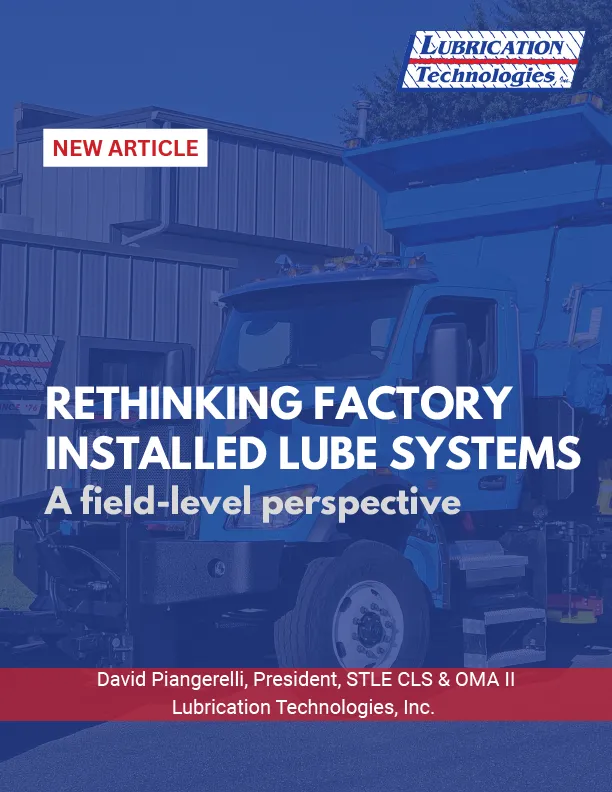
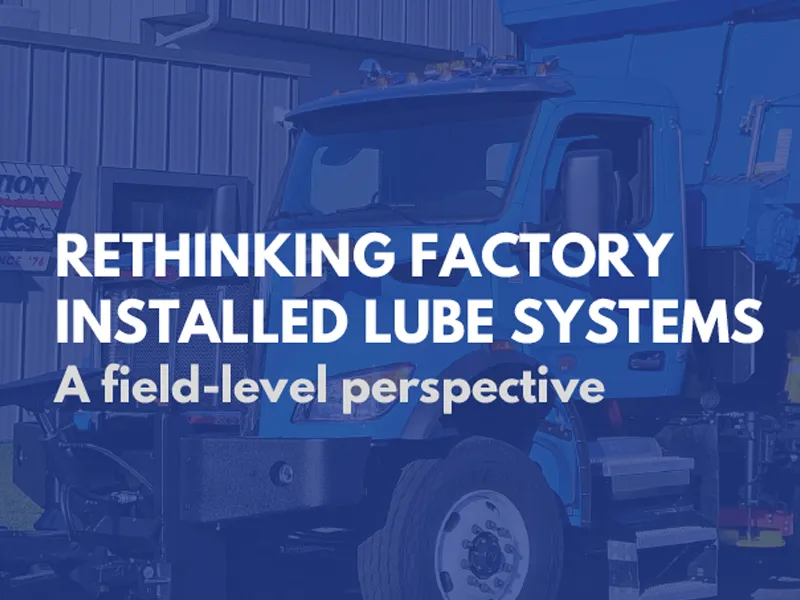
Rethinking Factory Installed Lube Systems – A Field-Level Perspective
Authored by David Piangerelli, President, STLE CLS & OMA II Lubrication Technologies, Inc.
When ordering new heavy equipment, long lead times are often a reality. But when machines are needed immediately, buyers tend to pick from what’s available on the lot. As more people recognize the value of automatic lubrication, they want it pre-installed on equipment. But that’s not always possible, and when it is, the results can be mixed. On smaller machines like loaders and excavators as well as crushers, screeners, milling machines and trucks, factory installation often isn’t even an option. But when it is, convenience may not translate to performance or reliability. Checking a box to have a lube system installed before delivery is simple, but what happens after delivery often determines the true cost.
Built for Production, Not Serviceability
Factory-installed lubrication systems are not inherently flawed, but reliability and control are frequent problem areas. For example, some models integrate lube timing into the machine’s main controls, limiting settings to vague measurements such as “slow,” “medium,” or “fast.” That might look fine on paper, but real-world applications demand more precision. One Lubrication Technologies, Inc. (LTI) customer struggled to match grease delivery to actual field conditions. The system functioned, but never provided the assurance that each point received the appropriate lubrication. LTI resolved the issue by adding in-cab controllers, allowing operators to adjust lubrication delivery based on load, temperature, and duty cycle. The change was simple yet transformative, turning a deficient system into one that performs as intended.
Training and Complexity
Most dealers are not trained to service lubrication systems. Some won’t touch them. You’ve got a pump issue or a blocked valve? Good luck. That’s when our phones start ringing. Once on site, we often find a lube system design that is far more complicated than necessary, making basic service and adjustments difficult. And the worst part? The system probably cost more than it should have.
“EVERY MINUTE OF DOWNTIME HAS A PRICE”
Cost Isn’t Just a Line Item
Factory systems can come at a hefty premium. The total cost may run thousands of dollars higher than a field-installed system. What’s really being paid for is convenience. There is also a huge difference in approach. LTI designs systems for the machines in operation, providing accurate grease delivery to all points, with awareness of high temperature areas, and serviceability. Every hose is pressure-rated, each routing is designed to follow the machine’s contours, and real-world environmental factors are accounted for. All details about the installation are documented to support future service.
The Service Question
If a factory-installed system fails, support can be uncertain. Dealers may not have the parts or training to repair it, resulting in downtime and frustration. Some designs do not provide for manual greasing if the pump malfunctions, forcing the machine out of service until the issue can be addressed. LTI approaches this differently. Every system is documented, supported, and stocked with readily available components. The same technicians who install them handle service, so problems get solved quickly. The goal is simple: keep the machine running.
The Smarter Long-Term Choice
None of this is to say OEM-installed systems can’t work. They can, and do, in the right conditions. But when the environment gets tougher, or when uptime really matters, the details start to separate factory convenience from field reliability. It’s about time and money.
We once serviced a machine equipped with an OEM unit that failed. The owner insisted on keeping it intact. From experience, we advised replacing it with our system instead, since the OEM components were overpriced and difficult to source. Diagnosing the issue and waiting for parts kept the machine down for two weeks. In the end, the repair cost $13,000. A complete LTI replacement, built for easier service with readily available parts, would have been about $10,000.
Every minute of downtime has a price. Before checking that box on the order form, take a closer look. Not because the factory option is wrong, but because there’s often a better solution.
About David Piangerelli
David Piangerelli is the President of Lubrication Technologies, Inc., bringing over 50 years of field experience in lubrication system design, installation, and reliability. He’s built a company grounded in doing the job right, training his team to carry that same standard forward and serving as a trusted resource for customers who depend on their equipment to last. David holds multiple certifications from the Society of Tribologists and Lubrication Engineers, including Certified Lubrication Specialist™ and Certified Oil Monitoring Analyst II™. He is available for site assessments, reliability training, and speaking engagements across uptime-critical industries.